
There is a particular pride that comes with a car that looks exactly as it did the day you drove it off the lot. The paint catches light in a way that feels almost alive. The surface is smooth under your fingers. The color is deep and saturated and unblemished. And then reality arrives. Sun. Rain. Road grime. Bird droppings. Automatic car wash brushes. Mineral deposits from hard water. Tree sap. Industrial fallout. All of it working quietly and relentlessly against the finish you love. Most people accept paint degradation as inevitable. But it is not. Ceramic coating protection is the most significant advancement in automotive paint protection in decades, and understanding how it actually works, not the marketing version but the chemistry and physics version, transforms it from a mysterious premium service into a genuinely logical investment in your vehicle’s long-term condition and value. This guide gives you that understanding completely.
What Ceramic Coating Actually Is: The Chemistry Behind the Protection
To understand how ceramic coating protection works, you need to understand what ceramic coating actually is at a chemical level. The term ceramic coating refers to a liquid polymer, specifically a silicon dioxide based compound, most commonly silicon dioxide derived from quartz, sometimes combined with titanium dioxide or other compounds depending on the formulation. The active ingredient in most professional-grade ceramic coatings is SiO2, silicon dioxide, in concentrations that typically range from fifty percent in consumer-grade products to ninety percent or higher in professional-grade formulations.
When this liquid is applied to a vehicle’s painted surface, it undergoes a chemical reaction with the clear coat and begins to cure through a process of cross-linking. The SiO2 molecules bond at a molecular level to the paint surface, forming a network of chemical bonds that create a semi-permanent layer of protection that is fundamentally different from anything wax or sealant can provide. Wax sits on top of paint and fills microscopic imperfections temporarily. Ceramic coating bonds to the paint and becomes, for practical purposes, a part of the surface itself. This distinction is not merely technical. It is the entire reason ceramic coating protection lasts for years while wax protection lasts for weeks.
The Hydrophobic Effect: Why Water Becomes Your Paint’s Best Friend
One of the most immediately visible and practically significant aspects of ceramic coating protection is the extreme hydrophobic effect it creates. Hydrophobicity refers to the tendency of a surface to repel water, causing it to bead up into droplets rather than spreading across the surface. Most uncoated or waxed automotive paint has a water contact angle of approximately sixty to ninety degrees. Professional-grade ceramic coatings create water contact angles of one hundred to one hundred fifteen degrees or higher.
What does this mean in practice? Water that contacts a ceramic-coated surface has no inclination to spread, sit or bond with the surface. It forms perfect spherical beads that roll off the paint surface at the slightest inclination, carrying with them the dust, dirt, road grime and other contaminants that were resting on the surface. This self-cleaning effect, sometimes called the lotus effect because it replicates the water-repelling property of lotus leaves, means that rain can literally wash a ceramic-coated vehicle clean of light surface contamination without any human intervention required.
Hydrophobicity and Chemical Resistance
The same molecular density that creates the hydrophobic effect also provides exceptional resistance to chemical attack. Bird droppings, tree sap, insect acids, industrial fallout, road salt, fuel spillage and the harsh alkaline and acidic chemicals used in automatic car washes all represent chemical threats to automotive paint. On unprotected clear coat, these substances can etch, stain, strip wax protection and cause lasting surface damage within hours or days of contact.
UV Protection: Shielding Paint From the Sun’s Long-Term Damage
Ultraviolet radiation from sunlight is one of the most damaging forces acting on automotive paint over a vehicle’s lifetime. UV radiation breaks down the chemical bonds in clear coat polymer chains through a process called photodegradation. Over time, this causes the clear coat to lose transparency, develop a dull, chalky appearance and ultimately fail structurally, leading to peeling and flaking that exposes the base coat underneath. This process is particularly rapid in regions with high solar intensity, at high altitudes where UV intensity is greater, and in dark-colored vehicles where the paint surface absorbs more solar energy.
Ceramic coating protection provides meaningful UV resistance through several mechanisms. The SiO2 network itself is highly stable under UV exposure, far more so than organic compounds. Some ceramic coating formulations also incorporate UV absorber compounds that capture and dissipate UV energy before it can reach the underlying paint. The combined effect is a significant reduction in the rate of UV-induced clear coat degradation that is most visible over time periods of years and most significant in high-UV environments.
Scratch Resistance: What Ceramic Coating Can and Cannot Do
Scratch resistance is one of the most frequently misunderstood aspects of ceramic coating protection, and the source of some of the most significant consumer disappointment when expectations are not properly calibrated. The hardness of a cured professional ceramic coating, at 9H on the pencil hardness scale, is genuinely impressive and provides real protection against specific types of surface marring. But it is important to understand both what this hardness means and what it does not mean.
The 9H hardness rating means that the coating will resist marring from objects softer than 9H hardness on the pencil scale. This includes the light scratching from dust and fine particulate matter that causes swirl marks when dry wiping or poor washing technique is used on unprotected paint, the micro-scratching from automatic car wash brush contact and the light surface marring from general environmental contact. These are the scratching mechanisms that most visibly degrade the appearance of automotive paint over normal ownership periods, and ceramic coating provides meaningful resistance to all of them.
The Swirl Mark Prevention Advantage
The practical significance of ceramic coating’s scratch resistance is most evident in the prevention of swirl marks, the fine circular scratches that become highly visible in direct sunlight and that are the most common form of paint degradation experienced by regularly driven vehicles. Swirl marks are caused by improper washing technique, automatic car wash brushes, dry wiping with towels or chamois and general environmental contact with abrasive particles. On unprotected paint, even careful washing can introduce fine scratches because any relative movement between a surface and an object harder than that surface, even a slightly contaminated wash mitt, causes micro-scratching.
The Application Process: Why Professional Installation Matters
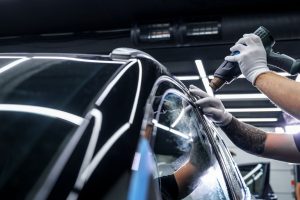
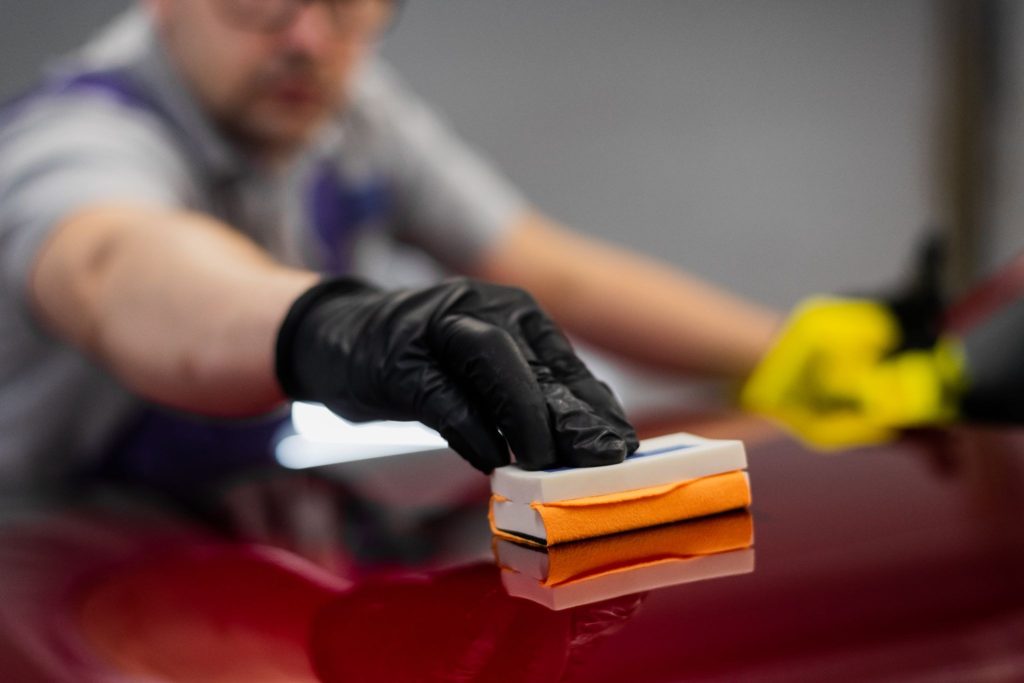
The application of a professional-grade ceramic coating is one of the most preparation-intensive detailing processes available, and the quality of the preparation work done before the coating is applied is every bit as important as the quality of the coating itself. Understanding the application process helps explain both why professional installation commands a significant price premium and why attempting to shortcut this process produces dramatically inferior results.
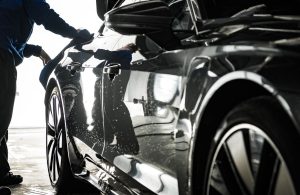
Surface preparation begins with a thorough decontamination process that goes far beyond a standard wash. Iron fallout remover is applied to dissolve iron particles embedded in the paint from road use and brake dust, particles that are invisible to the naked eye but that create raised contamination points in the paint surface. Clay bar treatment removes bonded surface contamination including industrial fallout, tree sap residue and other organic and inorganic material that washing cannot address. These steps are non-negotiable prerequisites because any contamination present on the paint surface at the time of coating application will be sealed beneath the coating permanently.
Maintenance of Ceramic Coated Vehicles: Keeping Protection at Peak Performance
A common misconception about ceramic coating protection is that a coated vehicle requires no maintenance. While the coating dramatically reduces the intensity and frequency of maintenance required, it does not eliminate it. Understanding proper maintenance of a ceramic-coated vehicle is essential for maximizing the coating’s effectiveness and longevity.
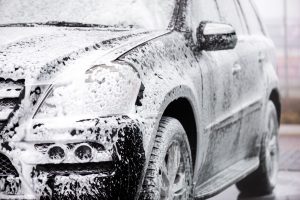
The primary maintenance requirement for ceramic-coated vehicles is regular washing using the two-bucket method or a foam cannon pre-soak to minimize contact contamination during the wash process. Even on a coated surface, wash mitt contact with a contaminated surface can introduce fine scratching, and the two-bucket method, using one bucket for clean shampoo solution and one for rinsing the mitt between passes, is the standard for minimizing this risk. pH-neutral automotive shampoos are recommended for coated vehicles because the alkaline detergents in some car wash products can degrade the coating’s hydrophobic properties over time.
Final Thoughts
Your vehicle’s paint is simultaneously one of its most visible features and one of its most vulnerable assets. Everything you love about how it looks, the depth of color, the clarity of reflection, the smoothness of the surface, is under constant attack from forces that most people never think about until the damage is already done. Ceramic coating protection does not make your vehicle immortal. It makes it dramatically more resilient than it would be otherwise, by applying cutting-edge chemistry to the challenge of keeping paint in the condition it deserves to be in. For anyone who loves their vehicle, values its appearance and wants to preserve its condition intelligently rather than reactively, ceramic coating is not a luxury. It is simply the smart choice made before the damage happens rather than after.